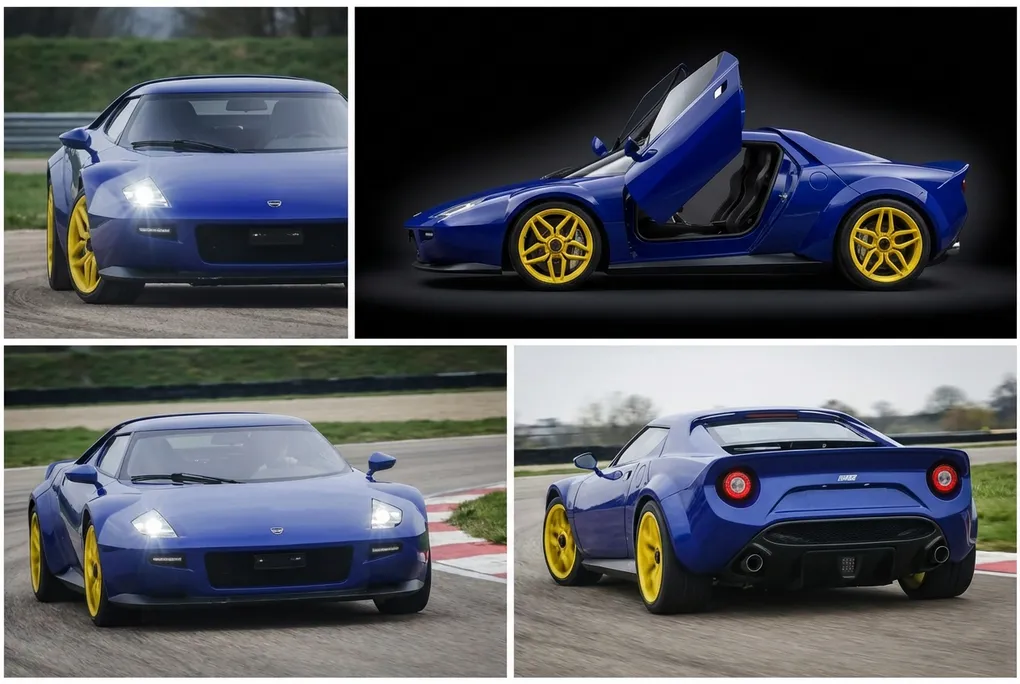
The New Stratos: Because Sometimes a Ferrari Needs a Hacksaw
If you were a child in the 1970s, or just a child at heart with excellent taste, the Lancia Stratos HF was likely plastered on your bedroom wall. It was a wedge of cheese designed by aliens to eat rally stages for breakfast. It was cramped, loud, dangerous, and absolutely perfect.
Fast forward to 2010. German billionaire Michael Stoschek decided the world was too boring and commissioned Pininfarina to build a modern successor. It was brilliant. It was beautiful. And then, Ferrari—in a move typical of a company that treats its brand like a sacred religious text—blocked production.
But you can’t kill a good idea. Enter Manifattura Automobili Torino (MAT), the automotive equivalent of the cool uncle who lets you drink beer at the family reunion. They have resurrected the project, and the result is the New Stratos.
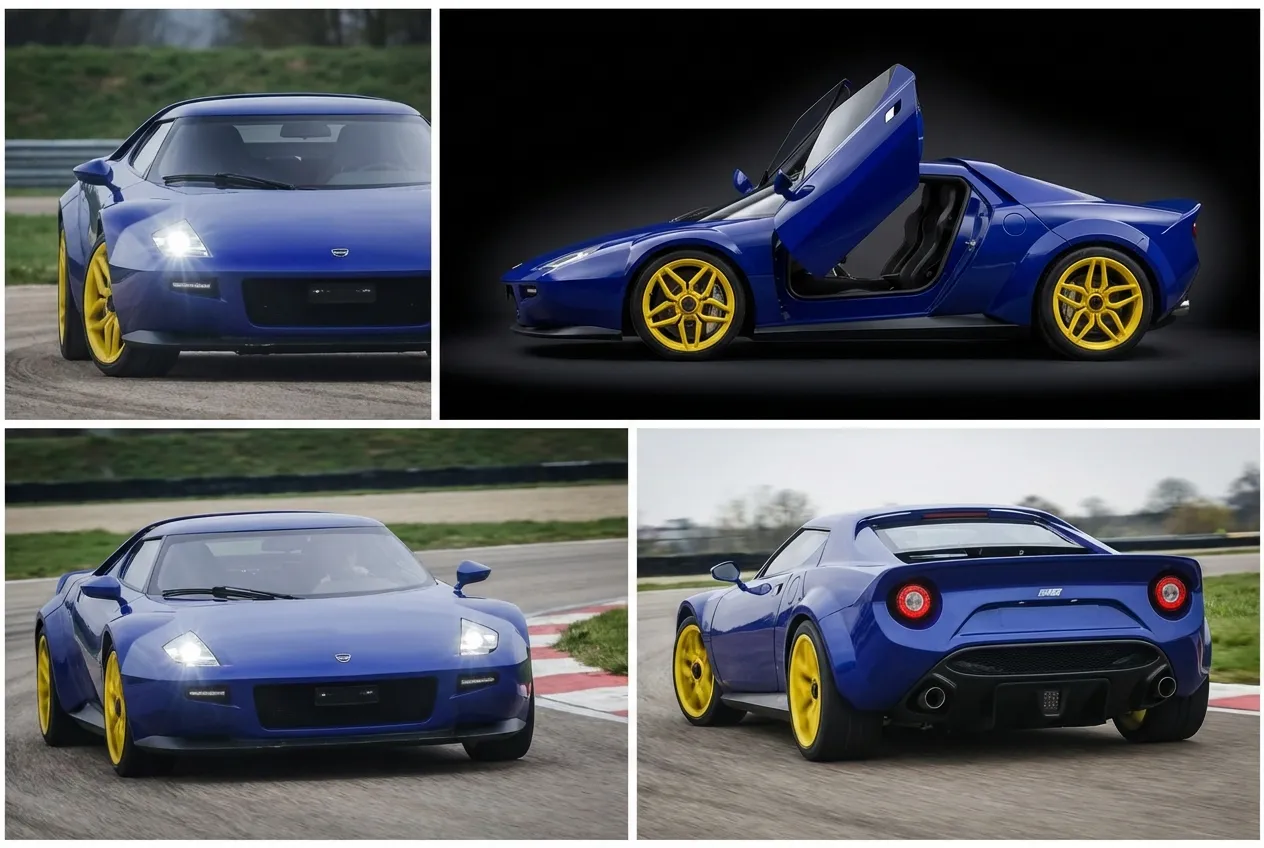
What in the World Is It?
Mechanically, the New Stratos is a Frankenstein monster wearing an Armani suit.
To build one, you must take a perfectly good Ferrari 430 Scuderia (or a standard F430), hand it over to MAT, and write them a check for roughly $617,000. They then proceed to take a hacksaw to the Maranello chassis, chopping 200mm (about 8 inches) out of the wheelbase.
They weld in an FIA-certified roll cage, drape the whole thing in carbon fiber bodywork, and tune the 4.3-liter Ferrari V8 to produce around 540 horsepower. The result is a car that weighs just 1,247 kg (dry)—significantly lighter than the donor Ferrari.
Think about that for a second. You buy a Ferrari. Then you pay more than half a million dollars to have someone cut it up. It’s like buying a Rolex and immediately taking it to a jeweler to remove half the links.
The Numbers That Matter
| Specification | New Stratos | Ferrari 430 Scuderia |
|---|---|---|
| Wheelbase | 2,400 mm | 2,600 mm |
| Weight (dry) | 1,247 kg | 1,250 kg |
| Power | ~540 hp | 510 hp |
| 0-100 km/h | ~3.3 sec | 3.6 sec |
| Top Speed | 274 km/h | 319 km/h |
| Production Run | 25 units | 499 units |
Notice how the top speed is actually lower than the donor car? That’s because this isn’t built for autobahn runs. It’s built for mountain roads where top speed is irrelevant and agility is everything.
Profile: The Manufacturer (MAT)
Who are they?
Manifattura Automobili Torino, or MAT, was founded in 2014 by Paolo Garella. If that name sounds familiar, it’s because he was the guy at Pininfarina who originally managed the New Stratos project for Stoschek. When Ferrari put up the stop sign, Garella eventually said, “Fine, I’ll do it myself.”
What’s their vibe?
MAT isn’t a traditional factory; they are a “boutique” car manufacturer based in Turin. They specialize in making the dreams of wealthy petrolheads come true. Aside from the New Stratos, they are the brains behind the Apollo Intensa Emozione (a car that looks like a spaceship) and the Glickenhaus SCG003 (a car that eats racetracks).
They are essentially the Navy SEALs of Italian coachbuilding: highly specialized, very expensive, and capable of executing missions that big OEMs are too scared to touch.
Their workshop isn’t churning out thousands of units. They work on maybe 5-10 cars at a time, each one essentially bespoke. If you want a New Stratos with lime green brake calipers and your grandmother’s name embroidered on the headrests, they’ll make it happen. For a price.
The Engineering: Surgery, Not Modification
Let’s talk about what actually happens when you hand over your Ferrari.
Step 1: The Chop
MAT removes the entire center section of the Ferrari chassis—200mm of tube frame. This isn’t a bolt-on kit you can install in your garage. This is structural surgery. They’re cutting load-bearing members and rewelding everything back together.
The shorter wheelbase transforms the handling characteristics. The polar moment of inertia drops dramatically, which is engineering speak for “this thing will change direction like a hummingbird on espresso.”
Step 2: The Cage
They install an FIA-spec roll cage. Not for show. Not for decoration. This is a full competition-grade cage that would pass scrutineering at Le Mans. Because when you make a car this fast and this twitchy, you’d better make sure the safety cell can survive a disagreement with a tree.
Step 3: The Body
The entire exterior is replaced with carbon fiber panels designed to evoke the original 1970s Stratos. The iconic “flying wedge” shape, the wraparound windshield that looks like a fighter jet canopy, the round taillights—it’s all there.
But it’s not a retro pastiche. The proportions are modern, the details are sharp, and the fit and finish (when done right) is spectacular.
Step 4: The Tune
The Ferrari F136 E V8 gets a proper MAT massage. ECU tuning, exhaust work (often a Capristo system that sounds like the apocalypse), revised intake, and careful weight reduction bring power up to around 540 hp.
More importantly, the power delivery is sharpened. The throttle response is immediate. There’s no turbo lag because there are no turbos. Just 4.3 liters of naturally aspirated Italian fury that screams to 8,200 rpm.
Pros and Cons
Is it the perfect supercar? Well, that depends on your definition of “perfect” and “terrifying.”
The Pros:
The Handling is Telepathic
Because they chopped 8 inches out of the wheelbase, the car has virtually no polar moment of inertia. You don’t steer it; you just think about a corner and the car is already facing the apex.
Reviews from people who’ve driven it describe the steering as “direct,” “immediate,” and “oh God oh God we’re going to die.” It’s the kind of car that makes modern Porsche 911s feel like cruise ships.
The Engine
It uses the Ferrari F136 E V8. It screams to 8,200 rpm and breathes through a Capristo exhaust that sounds like a war zone. This is the last generation of naturally aspirated Ferrari V8s before everything went turbo, and it’s glorious.
In an era where every supercar sounds like a vacuum cleaner with anger issues, the New Stratos howls like a banshee being murdered by a chainsaw. In the best possible way.
The Look
It retains the iconic “flying wedge” shape, the round taillights, and the wraparound windshield of the 1970s original. It is objectively stunning.
Park it anywhere and you will draw a crowd. Most people won’t know what it is. Some will think it’s a kit car. The ones who do know will lose their minds.
Helmet Storage
Just like the original rally car, the door pockets are shaped specifically to hold a racing helmet. Because you never know when a groceries run will turn into a Special Stage.
This is the kind of detail that separates a poseur’s toy from a driver’s tool. MAT knows who this car is for, and it’s not for people who need cupholders.
Manual Gearbox
Unlike the donor Ferrari Scuderia, which only came with paddles, MAT offers a manual conversion. Save the stick shift!
Yes, the F1-style automated manual is faster. No, nobody cares. If you’re spending $617,000 to cut up a Ferrari, you want three pedals and a stick.
The Cons:
The Price Tag
You have to buy a Ferrari 430 Scuderia (currently skyrocketing in value) and then pay MAT over half a million dollars to cut it in half.
Total investment? North of $900,000 once you factor in shipping, donor car purchase, and any customization. That’s McLaren 765LT money. That’s Porsche 911 GT2 RS money. That’s “I could buy three brand-new Corvette Z06s” money.
It’s Twitchy
Remember that short wheelbase? It makes the car agile, but it also means it wants to swap ends if you lift off the throttle mid-corner. It has been described as having “no hesitation, no roll… and no warning.”
This is not a car for YouTube influencers who learned to drive in a Tesla. This is a car for people who’ve spent time on track, understand weight transfer, and know how to catch a slide before it becomes a crash.
Interior Fit & Finish
While it has carbon fiber everywhere, some reviews note that the interior feels a bit “home-brewed” compared to a factory Ferrari, reusing old switchgear from the donor car.
You’re not getting an Italian leather palace with stitching patterns approved by a committee of artisan monks. You’re getting a functional race car interior with some of the donor Ferrari’s bits still visible. Some people love the honesty. Some people wish they’d spent more on the cabin.
Availability
MAT is only building 25 units. Good luck finding one.
As of 2026, most of the production run is sold out. If you want one, you’ll need to either wait for someone to sell theirs (unlikely) or hope MAT does a second batch (also unlikely). This is not a car you casually order.
Who Is This Car For?
The New Stratos is not for the person who buys a Lamborghini to park in front of a Gucci store. It is for:
1. The Masochistic Purist
You think modern Ferraris are “too safe” and “too easy” to drive. You want a car that challenges you to a duel every time you enter a roundabout.
You own multiple sets of racing gloves. You know what “trail braking” means. You’ve read Enzo Ferrari’s biography. Twice.
2. The Rally Historian
You sleep in Alitalia-branded pajamas and believe the 1970s were the peak of human civilization.
Your favorite movie is C’était un Rendez-vous. You can name all the World Rally Championship winners from 1973 to 1985. You think Colin McRae was a saint.
3. The “One of One” Collector
You are bored with limited-edition McLarens that are produced in the hundreds. You want something your billionaire neighbor literally cannot buy because they are all sold out.
Your garage already has a Carrera GT, a Lexus LFA, and a McLaren F1. You need something that will make those cars look common.
The Verdict
The New Stratos is a rolling contradiction. It is a German’s dream, designed by Italians, banned by Ferrari, and built by a boutique Turin workshop using the organs of a dead supercar. It is impractical, financially irresponsible, and slightly dangerous.
In short, it is everything a supercar is supposed to be.
It’s not the fastest. It’s not the most comfortable. It’s not the best investment. But it is one of the most special cars you can buy. It’s a love letter to an era when rally cars were mid-engined wedges of madness, and winning meant surviving, not just going fast.
If you have the means, the skill, and the courage, the New Stratos is the automotive equivalent of buying a ticket to the moon. It’s terrifying, it’s beautiful, and you’ll remember it forever.
Just make sure you bring a helmet. The door pockets are waiting.